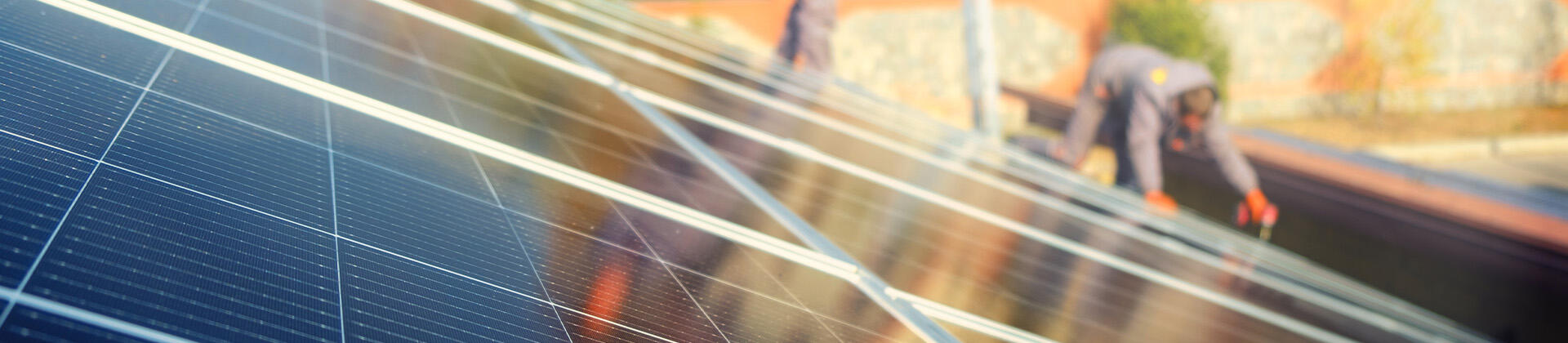
Many households or enterprises may encounter such a situation when installing photovoltaic systems: the roof is not uniform, with different inclination angles on the same roof. For example, some areas are inclined at 30°, and others at 10°. Such a complex roof structure can actually bring hidden "minor troubles" to photovoltaic power generation.
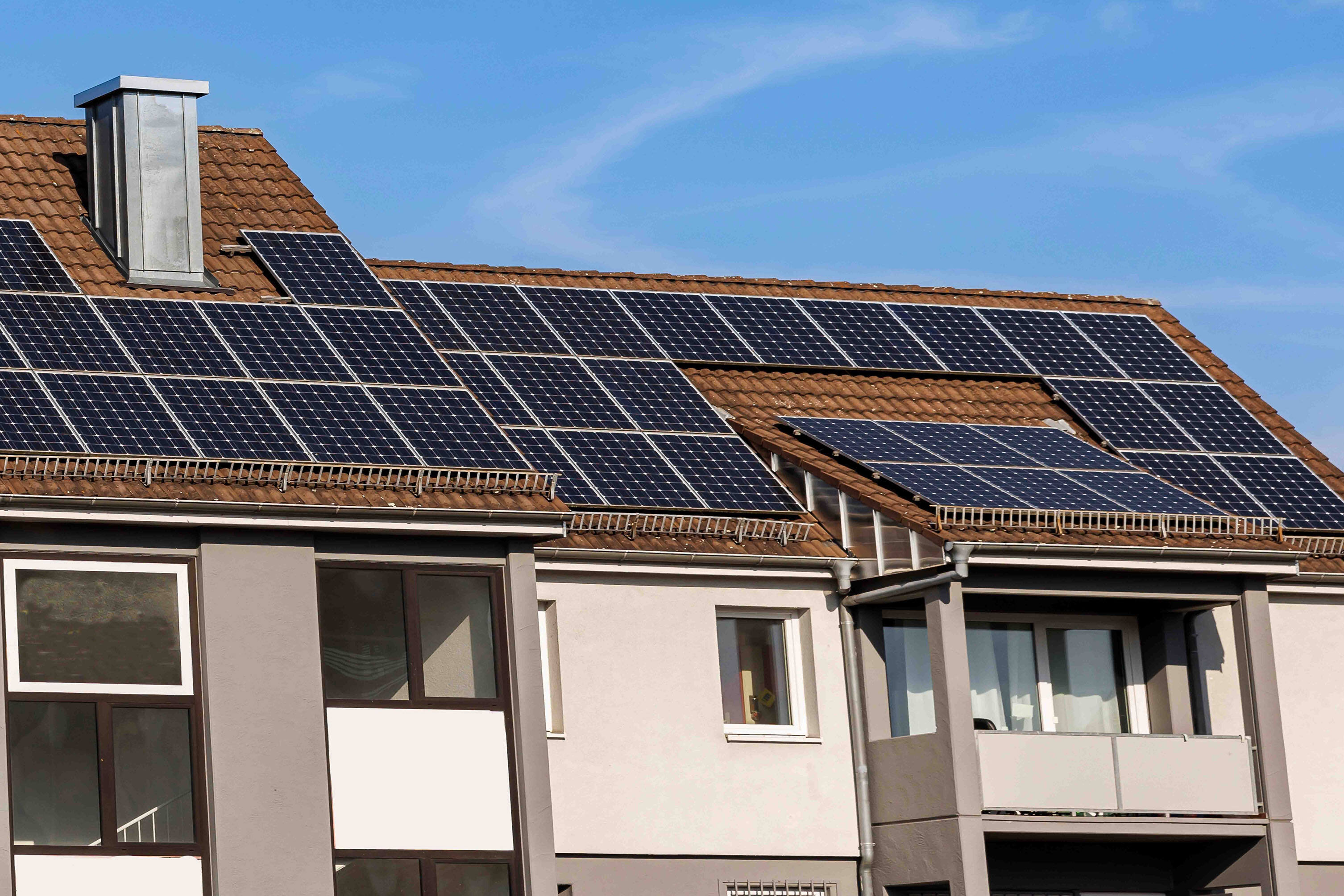
Why do different inclination angles have an impact? This starts with the power generation principle of photovoltaic modules. The generated current of photovoltaic modules is directly related to the received solar irradiance intensity, and the inclination angle is a key factor affecting irradiance absorption — when the angle is appropriate, the modules can capture sunlight more fully; if the angle is too gentle or too steep, it may reduce the amount of irradiance absorbed.
Suppose we want to make full use of the roof space and connect the photovoltaic modules in the 30° and 10° inclined areas in series to form a string. At this point, problems will emerge: Assume that the 30° inclined modules, due to more sufficient received irradiance, can generate a current of 10A, and a single module can achieve full-power generation of 400W (calculated at an operating voltage of 40V: 40V × 10A = 400W); while the 10° inclined modules, due to weaker irradiance, can only generate a current of 8A.
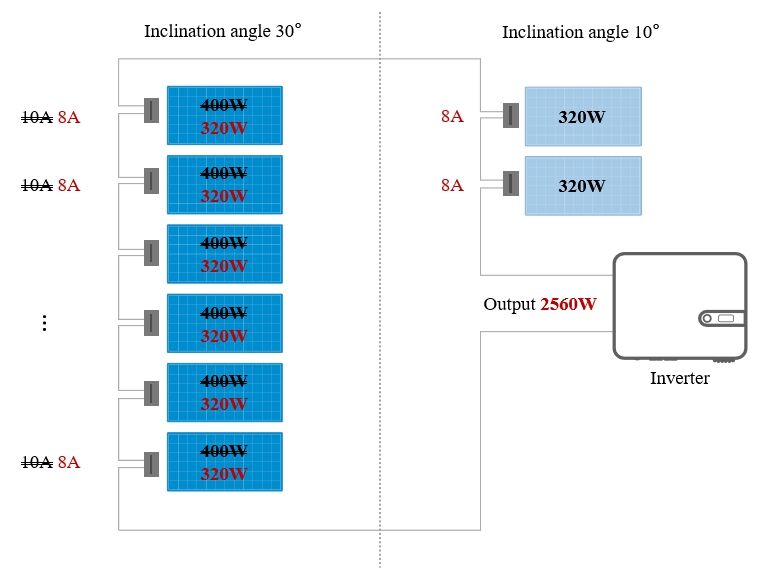
But series circuits have a characteristic: the current of the entire circuit is determined by the "minimum current". In other words, in this string, the operating current of all modules will be limited to 8A, the current of the 10° modules. This forces the power generation of the 30° modules to "downgrade": the originally 400W modules can only output 40V × 8A = 320W at this time. If there are 8 modules in the string (2 at 10°, 6 at 30°), the total power of the entire string becomes 320W × 8 = 2560W, and the power generation efficiency is significantly reduced.
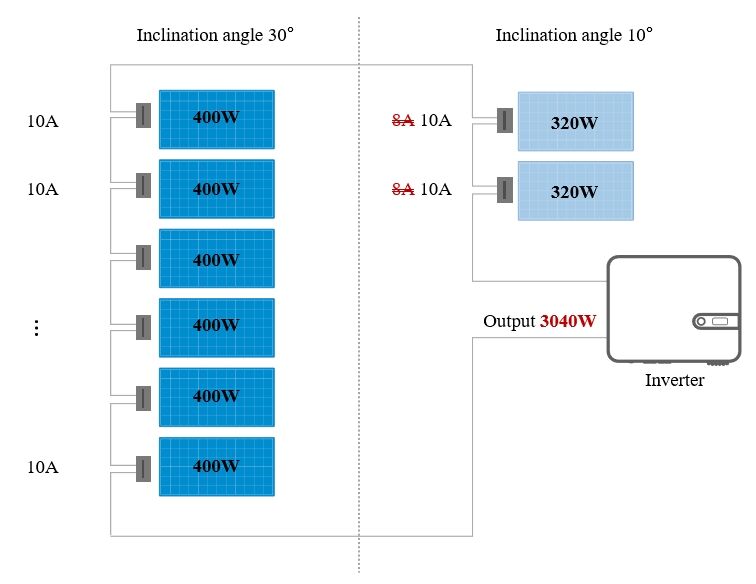
At this point, smart PV optimizers can play a "rescue" role. By installing optimizers on the modules, the operating status of each module can be independently regulated: The voltage of the 10° modules will be reduced to boost their 8A current to 10A, while the 30° modules can release their original 10A current and maintain a full-power output of 400W. Taking the same string with 2 modules at 10° and 6 modules at 30° as an example, the total power becomes 320W × 2 + 400W × 6 = 3040W. Compared with the previous 2560W, this is equivalent to recovering 18.75% of the power generation loss.
We also post our resources on social media. Follow us!
Contact (Position): Fascinatio Boulevard 708-8530 2909 VA Capelle aan den IJssel, The Netherlands
Phone: +31 (0) 634 885 233
Email: [email protected]
Copyright © Sungo Energy Technology (Jiangsu) Co., Ltd All Rights Reserved
 EN
EN
 AR
AR
 CS
CS
 NL
NL
 FR
FR
 DE
DE
 IT
IT
 JA
JA
 PT
PT
 ES
ES
 TH
TH
 TR
TR